
Baltimore Obituary Records
Baltimore obituary records stretch back to the 1870s, making this city one of the richest sources of death and burial data in Maryland. As an independent city with its own registration system, Baltimore kept death records separate from the rest of the state until 1972. You can search those records today through the Maryland State Archives, the Enoch Pratt Free Library, and the Division of Vital Records. This guide explains what exists, where it lives, and how to find obituary and death records tied to Baltimore city.
Baltimore City Overview
Baltimore City Death Records
Baltimore is an independent city. It separated from Baltimore County in 1851 and has operated its own government ever since. Death registration in the city began around 1874 to 1875, run by the Mayor and City Council. Those records stayed local until 1972, when they merged into the statewide system. That history means Baltimore obituary and death records come from two different systems depending on the year you are looking for.
For deaths from 1875 to 1972, the Maryland State Archives holds the Baltimore City death indexes and certificates. These are organized into several series. The Baltimore City Death Indexes covering 1875 to 1972 are available online through the Archives at msa.maryland.gov. The 1875 to 1972 indexes use vowel-based search codes. The 1943 to 1949 index is a separate series (MSA S1483). Records from 1950 to 1972 use Soundex, a phonetic coding system that groups names that sound alike. This can help when a family name was spelled different ways over the years.
Death certificates themselves follow a similar split. Certificates from 1875 to 1923 (MSA CM1132) are free to view online through the Archives. Certificates from 1924 to 1949 are on searchroom computers at the Archives in Annapolis. Records from 1950 to 1972 (MSA CE502) and from 1973 to 2014 (MSA SE46) are also in the searchroom. For deaths from 1969 forward, the Division of Vital Records handles certified copies for the whole state, including Baltimore City.
There is also a specialized series worth knowing about. Baltimore City Hospital Deaths from 1914 to 1919 (MSA CM1140) are available free online. If an ancestor died in a city hospital during that period, this series may have the record you need. The Archives also holds records from the Baltimore Board of Health going back several generations.
Maryland State Archives for Baltimore Obituaries
The Maryland State Archives in Annapolis is the main place to access older Baltimore death and obituary records. The Archives holds death indexes from 1875 to 2014 and certificates going back to the same year. You can search the online catalog and access many records remotely. The searchroom at 350 Rowe Blvd, Annapolis is open for in-person visits when you need records not yet digitized. Call ahead at 410-260-6400 to confirm hours and availability.
The Archives runs a vital records search tool at vitalrec.msa.maryland.gov that covers statewide death records. For Baltimore City specifically, the depth of the collection is exceptional. Death indexes going back 140 years are available to search by name, and many of the actual certificates from the earliest decades can be viewed for free. The Archives guide to death records is one of the best starting points for anyone researching Baltimore obituaries from the 19th and early 20th centuries.
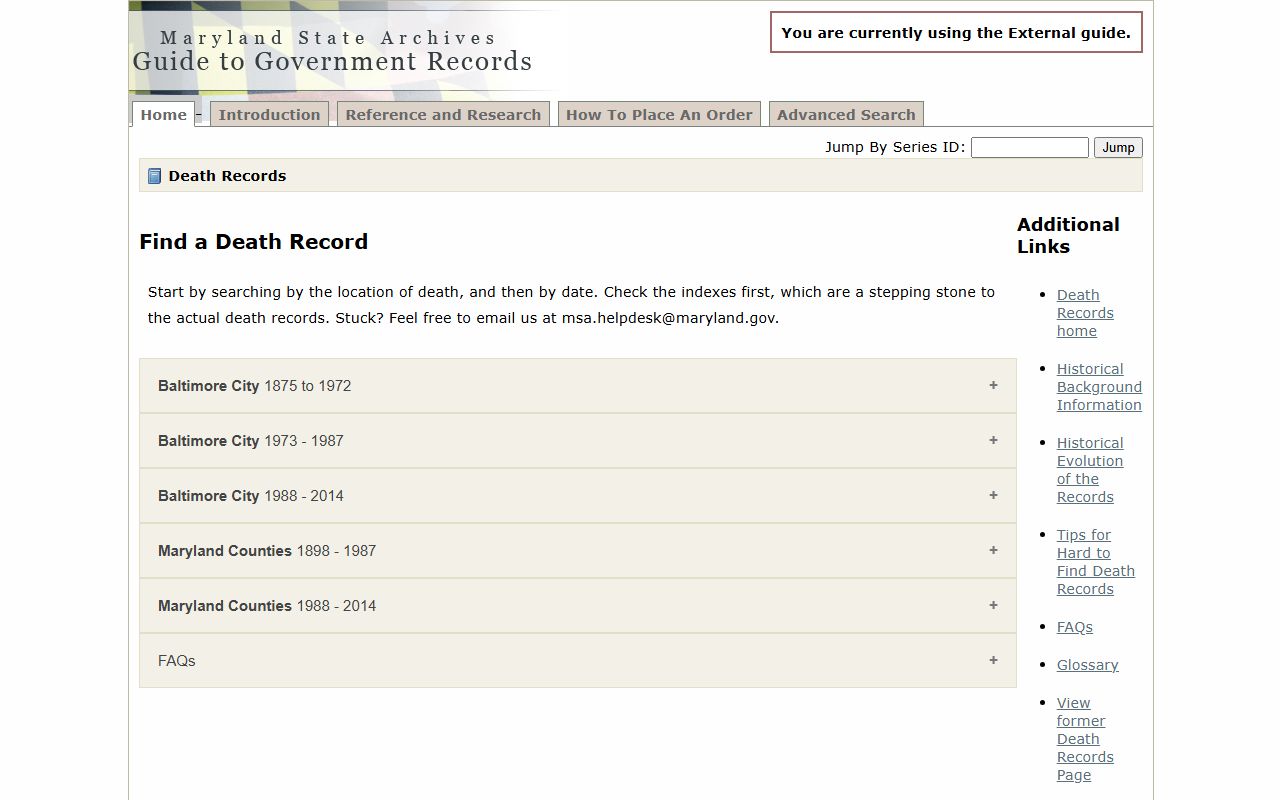
The Archives maintains a guide to death records at guide.msa.maryland.gov that breaks down every series by year range and call number. That guide is worth reading before you visit in person or place an order. Note: Records not yet digitized must be viewed in the searchroom or ordered as copies for a fee.
Division of Vital Records
For recent deaths, the Division of Vital Records handles certified copies for all of Maryland, including Baltimore City. Their office is at 6764B Reisterstown Road, Baltimore, MD 21215. The mailing address is P.O. Box 68760, Baltimore, MD 21215-0036. Phone: 410-764-3038. You can also order online through health.maryland.gov/vsa/.
Death certificates from 1969 to the present are available through this office. Certified copies are used for legal and estate matters. If you only need to confirm a death occurred, the online indexes at the Maryland State Archives may be enough. For an official certified copy, you need to go through the Division of Vital Records or order through VitalChek. The Division also handles orders placed at shop.msa.maryland.gov.
Baltimore City Hall also has some vital records available. Room 250 at 100 N. Holliday St, Baltimore, MD 21202 offers birth, death, and marriage certificates. This can be a local option for Baltimore residents who want to visit in person rather than going to Annapolis or ordering by mail.
Enoch Pratt Free Library Obituary Resources
The Enoch Pratt Free Library is one of the oldest free public library systems in the United States. It opened in 1934 and has become a key research hub for Baltimore obituaries and death notices. The Maryland Department within the library holds genealogy resources that go well beyond what most people expect from a public library. If you are looking for Baltimore obituary records tied to specific newspaper dates, the Pratt library is one of the best options in the city.
The Periodicals Department specializes in death notices from Baltimore newspapers. You can provide a date within five days of when you think the death was announced, and staff will search the relevant papers. Historic newspapers on microfilm cover many decades of Baltimore history. The library also holds US census records for Maryland, Baltimore City Directories from 1800 to 1950, naturalization indexes and petitions, and passenger lists for the Port of Baltimore from 1820 to 1948. For researchers with African American ancestry, the African American Department holds slave narratives, cemetery records, and other specialized materials. Visit prattlibrary.org/research for the full list of genealogy resources available.
Baltimore Newspaper Death Notices
Baltimore newspapers are a rich source for obituary records going back to the early 1800s. Several published indexes and transcribed collections make it easier to search these records without going through microfilm page by page.
Some of the key newspaper-based obituary resources for Baltimore include an index to marriages and deaths in The Sun from 1837 to 1850, a collection called Departed This Life covering death notices from The Sun from 1851 to 1860, and Maryland Mortalities from the Baltimore Sun Almanac covering 1876 to 1915. There are also compiled marriages and deaths from Baltimore newspapers going back to 1796. These collections vary in format but most are available through the Maryland State Archives, the Pratt library, or local genealogy groups.
Genealogy Trails Baltimore at genealogytrails.com/mary/balticity/ has transcribed death notices from Baltimore newspapers spanning the 1790s through the 1900s. These are free to search online and can be a fast first step before ordering a full death certificate.
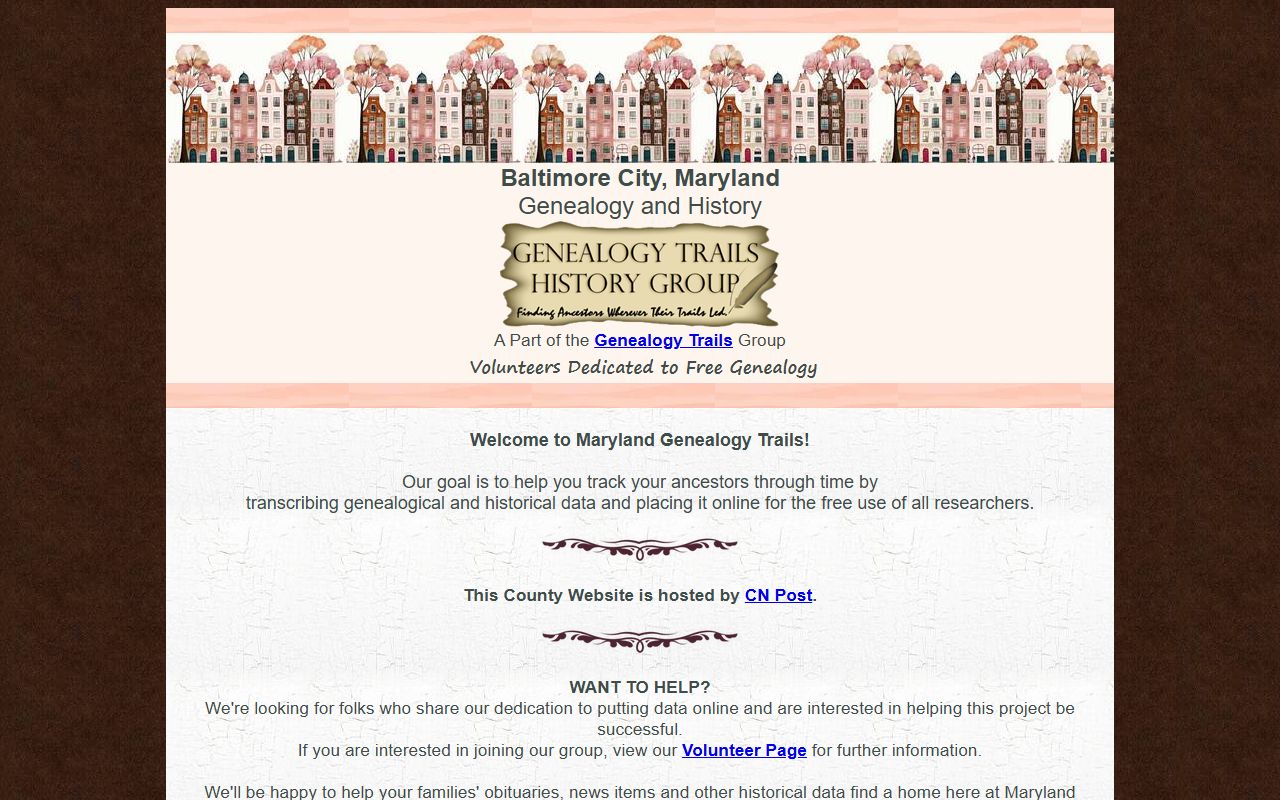
The Genealogy Trails collection pulls notices from multiple Baltimore papers across different decades. It is not exhaustive, but it covers enough ground to be useful for many families researching Baltimore obituary history.
Baltimore City Archives
The Baltimore City Archives serves as the central depository for records created by Baltimore City government. It works closely with the Maryland State Archives and holds a wide range of historical records tied to city operations. A guide called "A Guide to Research in the Public Records of Baltimore City" is available online and walks researchers through the collection. You can learn more at baltimorecity.gov/government/archives.
For obituary research, the City Archives is most useful for records that the state archives may not hold, such as city burial permits, Board of Health records, and other municipal death-related documents. Researchers working on Baltimore family histories often use both the City Archives and the State Archives together to build a complete picture. The two collections complement each other, and the published guide helps you figure out which to visit first.
Note: The City Archives is oriented toward researchers with specific record requests. It is not a walk-in genealogy center, so contact them in advance to confirm what is available and how to access it.
Online Baltimore Obituary Search
Several online platforms can help you search Baltimore obituary records without visiting a physical location. The Maryland State Archives online catalog at msa.maryland.gov has free access to many digitized death indexes and certificates. MyHeritage at myheritage.com holds Maryland vital records collections that include Baltimore death data. These platforms index records in different ways, so searching more than one often produces better results.
The Archives vital records search tool at vitalrec.msa.maryland.gov is designed for finding specific individuals. You can filter by county or city and by year range. For Baltimore City records before 1972, the system draws on the death indexes held at the Archives. Results may point you to a microfilm series or a digitized certificate that you can view on screen. For post-1969 records, the search will direct you to the Division of Vital Records process for ordering certified copies.
Baltimore County Obituary Records
Baltimore City is an independent city and is not part of Baltimore County. They are two separate jurisdictions. If you are researching someone who lived in Baltimore County rather than Baltimore City, that county has its own records and court system. Visit the Baltimore County page for court contacts, historical society resources, and county-level obituary research tools.
Nearby Cities
Looking for obituary records in cities near Baltimore? These qualifying Maryland cities also have dedicated obituary record pages.